

What Factors Determine the Cost of Repairing a Screw Air Compressor That Fails to Build Pressure?
Article reviewed by the PhuAir Technical Department – Updated: 05/09/2026
Air compressors that have been repaired but experience pressure drops again after some time are not uncommon in factories. If the focus is only on repairing the compressor while overlooking the piping, air treatment equipment, points of use, and air demand, the problem may recur.
Low pressure can cause compressed-air-consuming equipment such as CNC machines, automation equipment, cutting machines, or pneumatic control systems to operate unstably. At the same time, the compressor may have to remain loaded for longer periods, increasing energy consumption and affecting equipment service life.
Therefore, to prevent recurring air compressor pressure drops, it is necessary to control the entire air generation source, distribution system, and consumption points rather than addressing only a single component.
Quick Answer
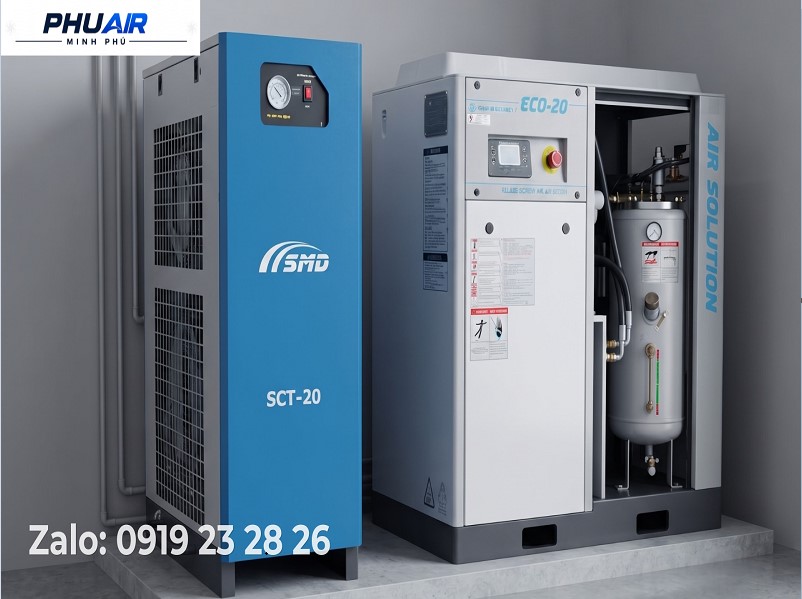
To minimize air compressor pressure drops, five key factors should be controlled:
Proper piping design, especially for systems with multiple points of use.
Control flow resistance across valves, filters, and air treatment equipment.
Inspect the Minimum Pressure Valve and related control mechanisms.
Set the operating pressure appropriately for actual demand.
Periodically inspect and repair compressed air leaks.
Values such as pressure drop, differential pressure across filters, or minimum pressure should only be considered reference values; actual specifications must be compared with the system design, compressor model, and manufacturer’s instructions.
Quick Diagnostic Table for Causes of Pressure Drops
Inspection Area | Common Indication | Recommended Action |
|---|---|---|
Main piping | Pressure is sufficient in the compressor room, but pressure is low at distant points of use | Check pipe diameter, route length, elbows/fittings, and piping layout; for suitable systems, a Ring Main can be used to distribute air more evenly |
Piping valves | Pressure drops significantly as air consumption increases | Check valve type, valve size, and open/closed condition; minimize unnecessary flow restrictions |
Air filters | Differential pressure increases and airflow decreases | Monitor differential pressure and replace the filter element according to the manufacturer’s recommendations |
Minimum Pressure Valve | Internal pressure is unstable, and the compressor behaves abnormally when switching load | Check the valve condition, spring, and moving mechanism according to the model-specific technical documentation |
Drain | Continuous air leakage noise at the discharge point | Check the automatic drain valve; clean or replace it when necessary |
System leakage | Compressor runs under load for extended periods but pressure remains difficult to maintain | Check fittings, flexible hoses, valves, drains, and air consumption points |
Air demand | Compressor runs continuously under load but pressure continues to decrease | Re-evaluate system air consumption and compressor FAD capacity |
1. Optimize the Piping System Using a Ring Main
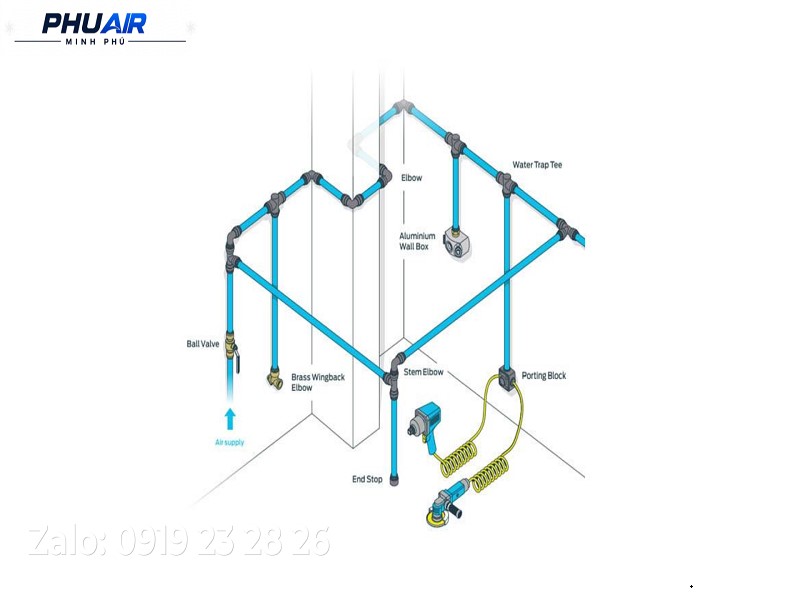
One of the reasons why compressor pressure is sufficient in the compressor room but low at the point of use is that the air distribution system has not been designed appropriately.
For factories with multiple areas using compressed air, a Ring Main system can allow compressed air to reach consumption points from multiple directions. This is particularly useful when multiple pieces of equipment are operating simultaneously.
However, a Ring Main is not mandatory for every system. Its actual effectiveness also depends on:
Total required air flow rate.
Pipe diameter and length.
Number of elbows, fittings, valves, and accessories.
Location of consumption points.
Required pressure at the end-use equipment.
An Important Consideration When Designing the Piping
For compressed air systems where condensate accumulation is a concern, the piping layout and air take-off points should be designed appropriately to limit condensate from entering the air-consuming equipment.
Taking branch lines from the top of the main pipe is a commonly used approach to help prevent condensate from being carried into the branch line by the airflow.
Do not simply increase compressor pressure to compensate for a piping system with excessive flow resistance. The source of the pressure loss should be identified before adjusting the operating pressure.
2. Control Flow Resistance Across Valves, Filters, and Air Treatment Equipment
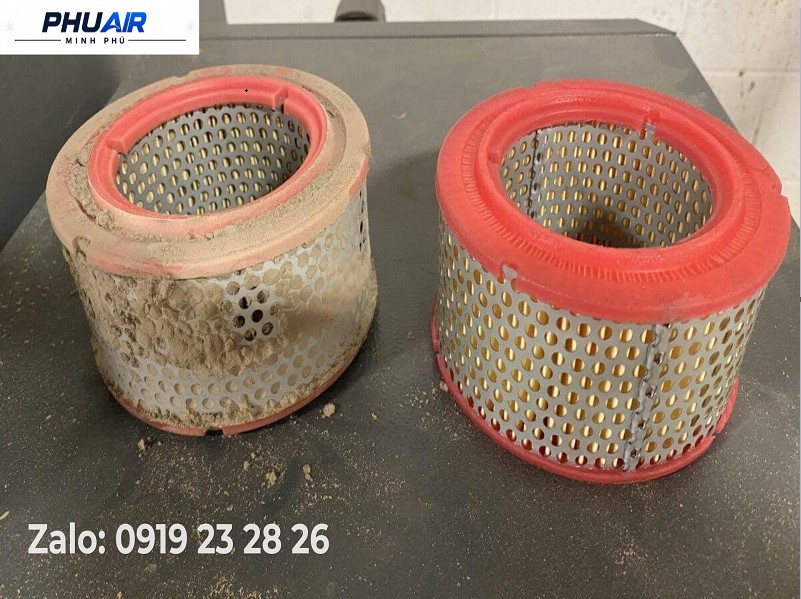
The pressure generated by the compressor does not necessarily equal the actual pressure at the end-use equipment.
Along the route from the compressor to the point of use, compressed air must pass through multiple components:
Compressor → Air Receiver → Filter → Air Dryer → Piping → Valves → End-Use Equipment
Each component can create pressure loss.
Dirty Filters
When the filter element accumulates dust or contaminants, flow resistance increases and the differential pressure across the filter also increases.
Therefore, visual inspection alone is not sufficient. If the equipment has a differential pressure gauge or sensor, monitor ΔP and compare it with the manufacturer’s limit.
For air filters, oil filters, and compressor oil separators, replacement should be based on:
Operating time.
Environmental conditions.
Oil quality.
Actual differential pressure.
Manufacturer’s recommendations.
Replacement filters such as Sakura air filters should only be used when their dimensions, filtration grade, and specifications are compatible with the equipment.
3. Check the Minimum Pressure Valve
The Minimum Pressure Valve is an important component in many screw air compressor designs. The valve helps maintain minimum pressure within the oil separator vessel assembly to support oil circulation and stable system operation.
The minimum pressure value is not the same for every model. Some designs may use a level of approximately 3.5–4.5 bar, but this should only be considered a reference range; the exact specification must be obtained from the manufacturer’s documentation.
If the valve is stuck, leaking, or not operating correctly, the compressor may exhibit abnormal pressure-related symptoms.
When inspecting the Minimum Pressure Valve, pay attention to:
Spring condition.
Piston or sliding mechanism surface condition.
Dirt and oil residue.
Sealing gasket.
Valve opening/closing operation.
Actual pressure according to the model-specific specifications.
Do not arbitrarily modify or adjust the valve mechanism simply to force the compressor to reach a higher pressure.
4. Set an Appropriate Operating Pressure
A common mistake when a system experiences pressure drops is to increase the compressor pressure setting to compensate for losses in the piping.
This approach may force the compressor to operate at a higher pressure than necessary, while the actual cause lies in the piping, filters, valves, or leakage.
Instead, the business should determine:
Required pressure at the end-use equipment → Pressure losses in the distribution system → Required pressure setting at the compressor.
In many systems, reducing operating pressure can help reduce energy consumption. Some technical documents use approximately 6–10% energy savings for each 1 bar reduction as a reference value under certain conditions. However, this is not a fixed ratio applicable to every compressor and every system.
Actual energy savings also depend on:
Compressor type.
Load/Unload mode.
VSD or fixed-speed compressor.
Air consumption.
Current operating pressure.
Overall system design.
Therefore, before reducing the pressure, it is necessary to confirm that the end-use equipment can still meet its required pressure.
5. Conduct Periodic Compressed Air Leakage Inspections
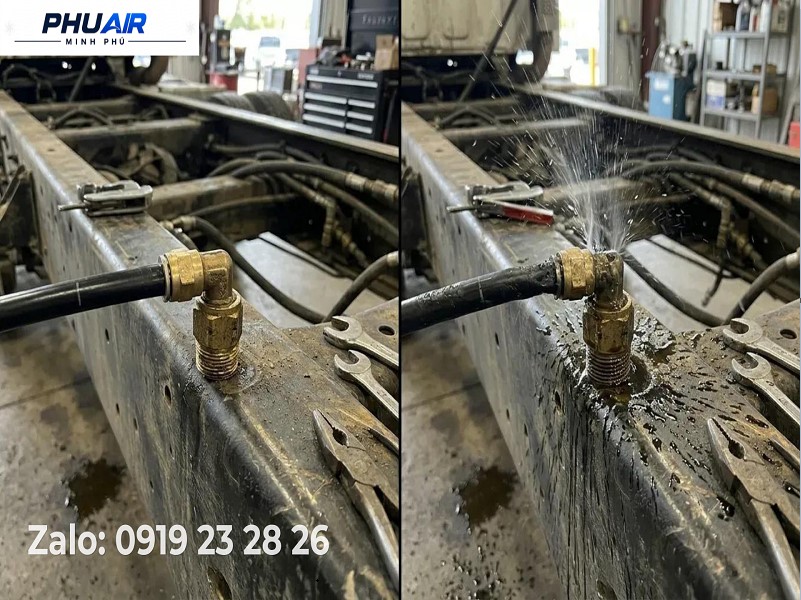
Leakage is one of the causes that is often overlooked when addressing air compressor pressure drops.
A small leakage point may not attract attention when inspected individually. However, if there are dozens or hundreds of leakage points throughout the factory, the total amount of lost air can become significant.
The following locations should be inspected:
Quick couplings.
Flexible hoses.
Threads and connections.
Isolation valves.
Drain valves.
Filters.
Pneumatic equipment.
Old or cracked piping.
How Should Leakage Be Checked?
For easily accessible leakage points, soapy water can be used to identify locations where bubbles appear.
For large factories or when more accurate inspection is required, ultrasonic leak detection equipment is more effective, particularly when conducting an audit during periods of low or no production activity.
6. 5-Step Inspection Procedure for an Air Compressor Experiencing Pressure Drops
When the problem recurs after repairs, the Airend should not be disassembled immediately. The following diagnostic sequence can be used to narrow down the cause:
Step 1: Identify Where the Pressure Drop Occurs
Measure and compare pressure at:
Compressor → Air Receiver → After Filter/Air Dryer → Main Piping → Point of Use.
The objective is to identify where the pressure is being lost rather than simply checking the gauge on the compressor.
Step 2: Check Air Demand
Determine whether the factory has:
Added new machines.
Increased production shifts.
Increased the number of air-consuming devices.
Equipment with abnormal air consumption.
If demand exceeds supply capacity, repairing the compressor will not resolve the root cause.
Step 3: Check for Leakage
Inspect piping, valves, fittings, and drains to rule out air losses.
Step 4: Check Flow Resistance
Measure differential pressure across filters and air treatment equipment. Check for undersized piping sections, valves with high flow resistance, or excessively long piping routes.
Step 5: Check the Compressor
After external factors have been eliminated, inspect:
Inlet Valve.
Solenoid valve.
Minimum Pressure Valve.
Oil separator.
Load/Unload system.
Temperature, current, and pressure parameters.
If disassembly is required, energy isolation (LOTO) and pressure release must be performed in accordance with the manufacturer’s procedures.
Mistakes to Avoid When Addressing Pressure Drops
❌ Arbitrarily Increasing the Pressure Setting
Do not increase the pressure beyond the design limit simply because the end-use equipment has insufficient pressure.
❌ Repairing Only the Compressor and Ignoring the Piping
The compressor may be operating completely normally while the losses actually occur within the distribution system.
❌ Replacing Filters Based on Guesswork
Not every type of filter needs to be replaced after the same fixed period. Operating time, environmental conditions, differential pressure, and the manufacturer’s recommendations should all be considered.
❌ Concluding Too Early That the Airend Is Damaged
Low pressure alone is not sufficient to conclude that the screw rotor pair or Airend is damaged. Control-related causes, filters, piping, leakage, and air demand should be ruled out first.
7. Frequently Asked Questions
Can undersized air piping cause an air compressor pressure drop?
Yes. Piping that is incorrectly sized for the flow rate can create significant pressure losses, particularly when the piping route is long or contains many elbows, fittings, and valves. In this case, pressure in the compressor room may still meet the required level while pressure at the end-use equipment is low.
Is a Ring Main mandatory for every factory?
No. A Ring Main can provide benefits for systems with multiple points of use and widely distributed air demand, but the piping design should be based on the actual flow rate, pipe diameter, piping length, and factory characteristics.
Can an air compressor pressure drop be caused by a clogged oil separator?
It can, but not always. A clogged oil separator is generally associated with increased differential pressure and can affect operating performance. ΔP and related symptoms should be checked before deciding to replace the separator.
Should compressor pressure be increased when pressure at the end of the piping is low?
It should not be done immediately. First determine whether the pressure loss is caused by the piping, filters, air dryer, valves, leakage, or air demand exceeding capacity. The pressure should only be adjusted after confirming that the system remains within its design limits.
8. PhuAir Supports Compressed Air System Pressure Drop Inspection and Resolution
If your air compressor continues to experience pressure drops after repairs, do not simply replace additional components before identifying the cause.
PhuAir can support businesses in narrowing down the cause from the compressor → air receiver → air treatment equipment → piping → point of use, thereby identifying the source of pressure loss and proposing an appropriate solution.
To help technicians assess the situation more quickly, you can provide:
Photo of the compressor nameplate: Brand, model, and power.
Photo/video of the controller display: Pressure, temperature, and warning code, if any.
Pressure at the point of use: If a pressure gauge is available.
Piping diagram: If the factory already has a system drawing.
Description of when the pressure drop occurs: Whether it drops immediately when the load increases or gradually during operation.
Based on this information, PhuAir can help narrow down the cause before recommending repairs or component replacement, helping the business minimize incorrect component replacement and reduce downtime.
Note: The technical parameters in this article are for reference. Pressure values, differential pressure, maintenance intervals, and corrective measures must be confirmed according to the compressor model, system configuration, and the manufacturer’s technical documentation.