

Does Running an Air Compressor Continuously Consume More Electricity?
During factory operations, many technical managers and business owners ask: “Does running an air compressor continuously consume more electricity?”
The short answer is YES. Continuous air compressor operation will certainly increase electricity costs. However, continuous operation does not necessarily mean electricity is being wasted.
The key is to clearly distinguish whether the compressor is running to meet actual production demand or is being forced to work harder to compensate for an inefficient operating system (air leaks, pressure drops, or incorrect settings).
In this article, PhuAir will help you analyze electricity consumption in detail for each operating state and explain how to optimize energy costs effectively.
1. Understanding Electricity Consumption When an Air Compressor Runs Continuously
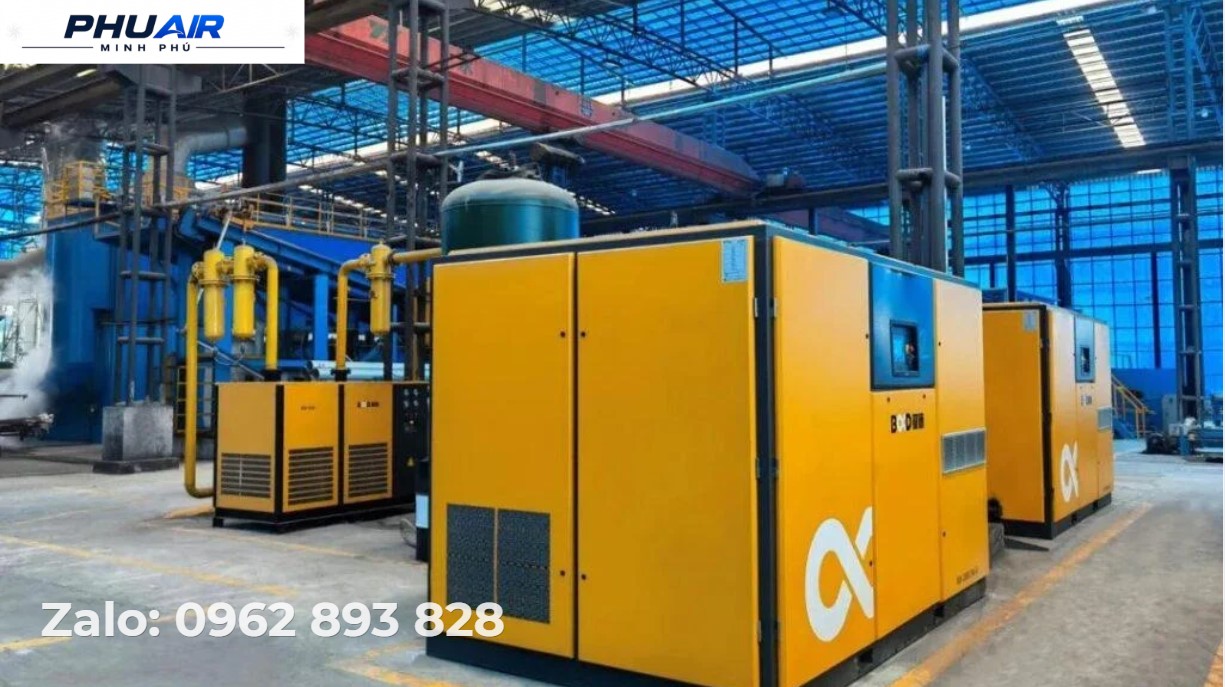
An air compressor uses an electric motor to drive the compression unit. In theory: Increased Running Time → Increased Electricity Consumption → Increased Operating Costs.
However, to accurately assess the level of electricity consumption, you cannot look only at the number of hours the motor runs. You need to clearly distinguish between two basic operating states:
⚡ When the Compressor Is in LOAD Mode (Loaded)
Operation: The compressor continuously draws in and compresses air to supply the system.
Power Consumption: The compressor operates at 100% of its rated power.
Assessment: If the factory is operating at peak production capacity, continuous LOAD operation is entirely normal, and the electricity consumed directly supports production.
⚡ When the Compressor Is in UNLOAD Mode (Unloaded)
Operation: The pressure has reached the cut-out threshold, the inlet valve closes, and the compressor stops producing additional compressed air, but the motor continues running to circulate oil and provide cooling.
Power Consumption: The compressor still consumes 30%–40% of its rated power.
Assessment: UNLOAD does not mean zero electricity consumption. If the air compressor frequently runs unloaded for extended periods without shutting down completely, this can become a major source of wasted electricity.
2. Four Causes of Excessive Electricity Consumption When an Air Compressor Runs Continuously
If factory output has not increased but the air compressor's loaded (LOAD) running time has become unusually long, your system may be experiencing the following issues:
1. Compressed Air Leaks in the Piping Network
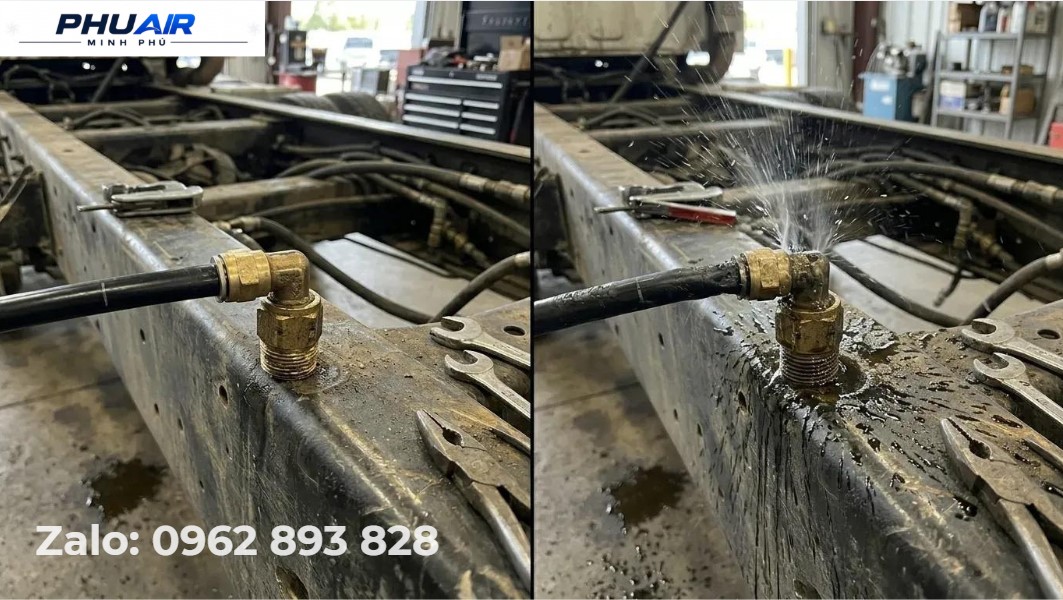
This is one of the leading causes of financial losses. The compressed air produced escapes through loose joints, faulty valves, or cracked hoses.
Waste Cycle: Compressor Produces Air → Air Leaks → Pressure Drops → Compressor Continues to LOAD to Restore Pressure → Electricity Bills Soar.
You are paying for electricity to produce air that does not contribute to production.
2. Set Pressure (Cut-out) Higher Than Actual Demand
Many factories habitually set their air compressors to the maximum pressure level (e.g., 8.5 bar), even though downstream equipment only requires 6.0 bar.
Forcing the compressor to operate at a higher pressure than necessary makes the motor work harder and consume more electricity in kWh.
3. The Compressor Runs Continuously Due to Pressure Drops / Insufficient Pressure
When the air filter is dirty, the inlet valve is stuck partially open, or the oil separator is clogged, the compressor's air production capacity decreases. Pressure rises very slowly, forcing the compressor to remain in LOAD mode continuously while the system still fails to receive the required air volume.
4. Improper Unload Run-Time Settings
If the automatic shutdown waiting period (Auto Stop Timer) is set too long, the compressor will remain in the UNLOAD state for extended periods during factory breaks between shifts or when air demand is very low, wasting electricity unnecessarily.
3. Data Collection Table for Identifying Electricity Waste
To determine whether your continuously running air compressor is actually “burning money,” collect the following actual operating data:
Data to Collect | Purpose of Assessment |
|---|---|
Compressor Power Rating (kW/HP) & Voltage | Determine the standard electricity consumption level. |
Total Running Hours / LOAD Time | Assess the proportion of time the compressor is actually producing useful compressed air. |
UNLOAD Time (Unloaded Operation) | Identify periods of wasted electricity when no air is being used. |
Set Pressure vs. Point-of-Use Pressure | Determine the pressure differential and the extent of excessive pressure settings. |
Compressed Air Leakage Across the Entire System | Assess the amount of air—and electricity costs—being lost to the environment. |
💡 Quick Warning Sign: PRODUCTION OUTPUT UNCHANGED + AIR DEMAND UNCHANGED, BUT COMPRESSOR LOAD TIME INCREASES — THE SYSTEM IS LIKELY EXPERIENCING AIR LEAKS OR A TECHNICAL FAULT!
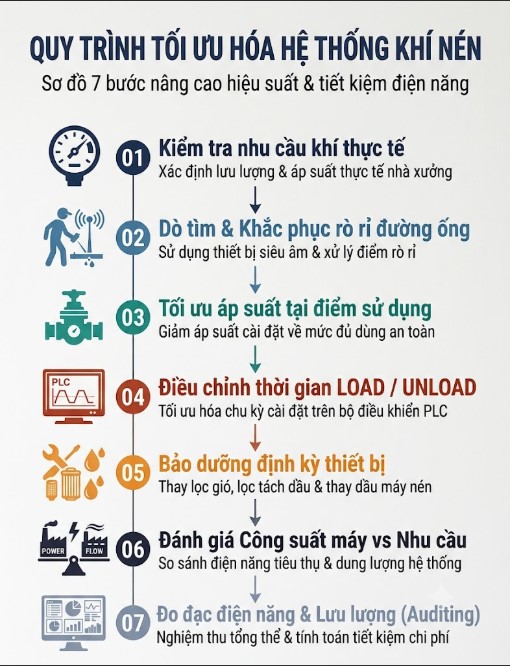
4. A 7-Step Procedure to Optimize Air Compressor Energy Consumption
According to the technical recommendations of PhuAir, when a compressor is found to be running continuously and consuming excessive electricity, businesses should not rush to purchase a new compressor with a higher power rating. Buying a larger compressor while the piping system is leaking will only increase the amount of air lost and drive electricity costs even higher.
Follow the standard seven-step inspection procedure below:
5. Frequently Asked Questions (FAQ)
Q1: Does an Air Compressor Consume Electricity When Running Unloaded (UNLOAD)?
Answer: Yes. In the UNLOAD state, the motor continues to run and consumes approximately 30%–40% of its rated power. If the unloaded period continues for an extended time, this can become a significant source of electricity waste.
Q2: Do Compressed Air Leaks Really Increase Electricity Bills?
Answer: Significantly. Air leaks force the compressor to spend more time in the loaded (LOAD) state to compensate for lost air, directly increasing monthly electricity consumption in kWh.
Q3: Should You Reduce the Air Compressor's Set Pressure to Save Electricity?
Answer: Do not reduce it without first conducting an assessment. Measure the minimum pressure required by downstream production equipment before making adjustments to avoid affecting production line operations.
CONCLUSION & SOLUTIONS FROM PHUAIR
An air compressor running continuously can increase electricity costs, but this alone is not enough to conclude that the system is wasting energy. Businesses need to determine whether the compressor is running to meet production demand or to compensate for air leaks and incorrect settings.
Rather than relying on theoretical electricity-saving percentages, PhuAir prioritizes a comprehensive system assessment: Compressor – Air Receiver – Piping – Points of Use, based on actual measurement data.
👉 Concerned that your factory's compressed air system is consuming too much electricity?
Contact the PhuAir engineering team for measurement, system assessment, and expert energy optimization solutions.