

Piston Air Compressor Fails to Build Pressure – A Sign That It Is Near the End of Its Service Life?
Article reviewed by PhuAir Technical Department – Updated: September 05, 2026
A piston air compressor that continues to run but fails to increase pressure, builds pressure very slowly, or fails to reach the required pressure level is a common issue during operation. This condition causes compressed air equipment to operate unstably, forces the compressor to run for longer periods, and may affect production efficiency.
So, why does a piston air compressor run but fail to build pressure?
Unlike a screw air compressor, which uses a pair of rotating rotors to compress air, a piston compressor generates pressure through the reciprocating motion of a piston inside a cylinder. Therefore, the causes are often related to the suction valve, discharge valve, piston rings, piston, cylinder head gasket, air filter, unloading mechanism, or piping and receiver system.
If you are using a screw air compressor, you can refer to the article [Screw Air Compressor Fails to Build Pressure]. If the compressor still builds pressure but the pressure build-up time is prolonged, see [Screw Air Compressor Builds Pressure Slowly or Has Low Pressure].
The following article helps you distinguish between the conditions and identify 6 main groups of causes before deciding to disassemble the airend or replace components.
Quick Answer
When a piston air compressor is still operating but fails to generate sufficient pressure, do not rush to disassemble the airend assembly. First determine whether the compressor is completely losing pressure or simply building pressure slowly, then check easily identifiable factors such as the pressure gauge, air leakage, air filter, unloading mechanism, and drive belt.
If the external factors are normal, the technician can then proceed with a more in-depth inspection of the intake/discharge valve assembly, piston rings, piston, and cylinder.
All disassembly and installation work must be performed after disconnecting the power supply, isolating the energy source, and fully releasing the pressure in the receiver to 0 bar, while also following the manufacturer's safety instructions.
Quick Diagnostic Table for a Piston Air Compressor That Fails to Build Pressure
Actual Symptoms | Suspected Component | Inspection Approach |
|---|---|---|
Compressor runs but pressure remains at 0 bar | Intake/discharge valves, unloading mechanism, pressure gauge, or major leakage | Check the pressure gauge, listen for air leakage, inspect the unloading mechanism and valve assembly |
No clear suction force at the intake port | Intake/discharge valve assembly, stuck or damaged valve plate | Inspect the condition of the valve plate according to the model-specific technical instructions |
Continuous air leakage around the intake port | Unloader/pilot valve or airend valve | Check the unloading mechanism and sealing of the valve assembly |
Pressure builds very slowly | Air filter, piston rings, intake/discharge valves, drive belt, or high air demand | Check intake airflow, compression efficiency, drive system, and load demand in sequence |
Significant oil vapor/smoke in the crankcase | Piston rings, cylinder, or breather system | Inspect the piston rings and cylinder wear condition |
Compressor runs continuously but has difficulty reaching the set pressure | System leakage, insufficient capacity, or unloading mechanism | Check for leakage, pressure build-up time, and actual air consumption |
📌 Have you identified the suspected component? [View the corresponding spare part codes] or contact PhuAir for assistance in identifying the correct model before placing an order.
1. Distinguishing Between a Compressor That Fails to Build Pressure and One That Builds Pressure Slowly
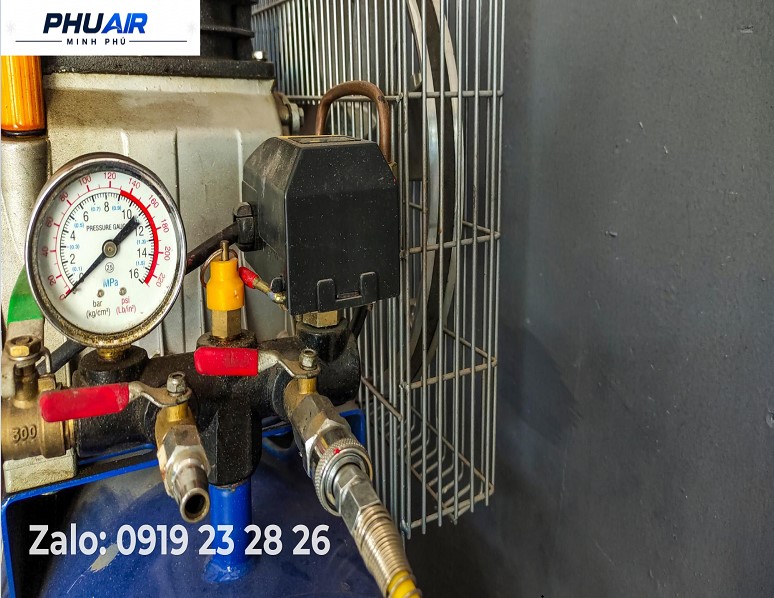
This is an important step before identifying the cause. The two conditions may have completely different causes.
Compressor Runs but Pressure Barely Increases
If the motor is still operating but the pressure gauge remains at 0 bar or barely increases when the compressor is required to charge the system, priority should be given to checking:
Intake/discharge valve assembly.
Unloading mechanism.
Large-scale air leakage.
Drive belt or drive mechanism.
Pressure gauge and signal line, if the system is equipped with a sensor.
Compressor Still Builds Pressure but Very Slowly
If the pressure continues to increase but takes longer than normal to reach the required pressure, the causes may be related to:
Dirty air filter.
Worn piston rings or cylinder.
Intake/discharge valve plate not sealing properly.
Loose or slipping drive belt.
Increased air demand.
Leakage in the piping or air-consuming equipment.
Do not conclude that the piston rings or airend are faulty based solely on the pressure build-up rate.
Simpler causes should be ruled out first.
2. 6 Causes of a Piston Air Compressor Failing to Build Pressure
2.1. Intake/Discharge Valve Assembly Damaged or Not Sealing Properly
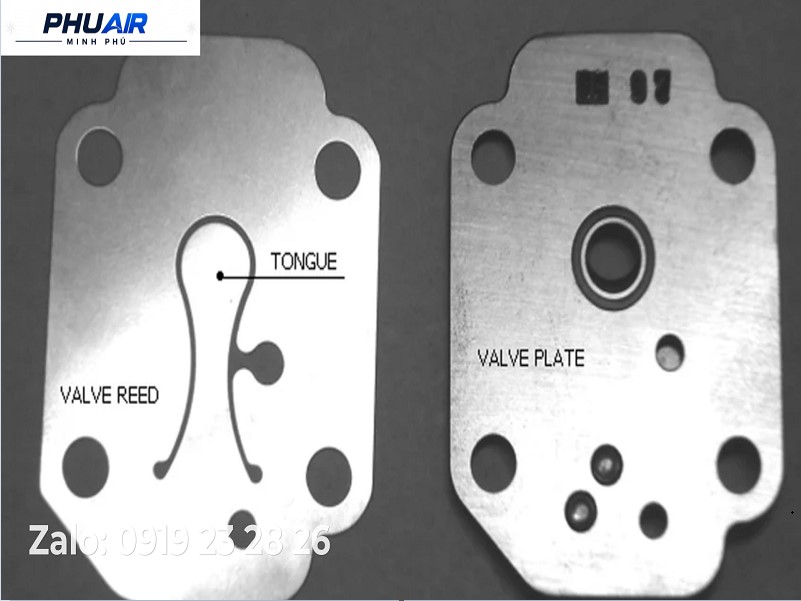
The intake and discharge valve assembly determines the direction of airflow during the piston’s suction–compression cycle.
When the valve plate is chipped, cracked, bent, covered with carbon deposits, or stuck, the valve may fail to seal properly. As a result, some of the air is forced back toward the intake port instead of being delivered to the receiver.
Possible Symptoms
The compressor runs but pressure increases very slowly or does not increase.
Abnormal air leakage is present at the intake port.
The airend operates but compression efficiency decreases.
The compressor runs hotter than normal because it has to operate longer to compensate for pressure loss.
Inspection Approach
After the energy has been isolated and all pressure has been fully released, the technician may inspect the valve plate assembly according to the service manual for the specific machine model.
Do not arbitrarily change the valve plate thickness, stroke, or installation method without the corresponding technical specifications.
2.2. Unloading Mechanism or Pilot Valve Stuck
Some piston air compressors are equipped with an unloading mechanism or centrifugal pilot valve.
This mechanism helps control the compressor’s load status. If the mechanical pin, spring, or valve becomes stuck in the unloading position, the compressor may continue running but fail to charge the receiver normally.
Identifying Symptoms
The compressor runs but has difficulty building pressure.
Continuous air leakage is heard at the unloading point or around the intake port.
The compressor does not switch between loaded/unloaded states normally.
Pressure in the receiver increases very slowly even though the compressor is still operating.
Inspection Method
Inspect the pin mechanism, spring, seals, and control air line according to the design of each specific model.
Do not arbitrarily adjust the screw or change the valve stroke without the manufacturer's standard specifications.
2.3. Air Filter Clogged
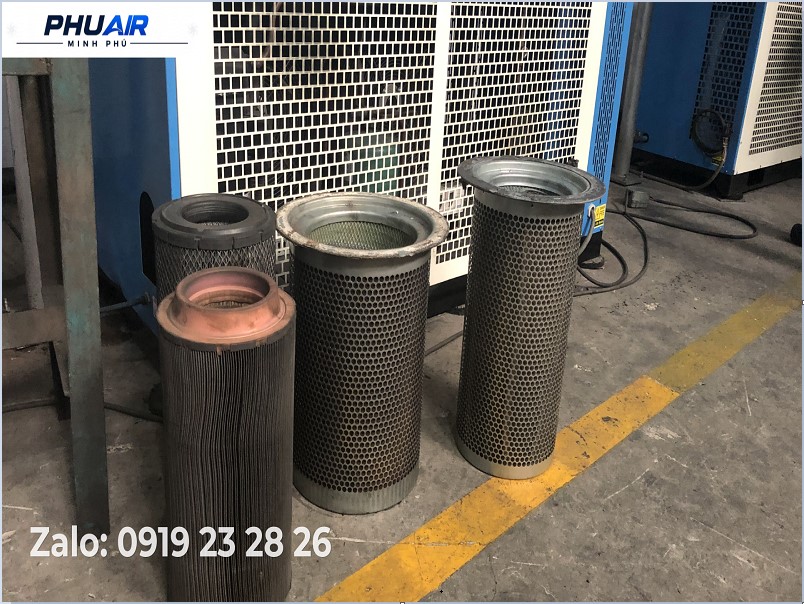
The air filter is responsible for removing dust and contaminants before the air enters the compression chamber.
When the filter is excessively dirty, the intake airflow decreases. The compressor continues to run, but the actual air flow rate is lower, resulting in a longer pressure build-up time.
This is one of the causes that should be checked early because inspecting and replacing the filter is generally simpler than disassembling the airend.
Important Considerations
A fixed filter replacement interval should not be applied to every compressor.
3,000 hours may be used as a reference interval under certain operating conditions, but the actual replacement interval should be based on:
Manufacturer's recommendations.
Operating environment.
Dust levels.
Filter differential pressure.
Actual operating hours.
Compressors operating in environments with high levels of dust, textile fibers, or production debris may require earlier filter inspection and replacement.
2.4. Worn Piston Rings or Cylinder
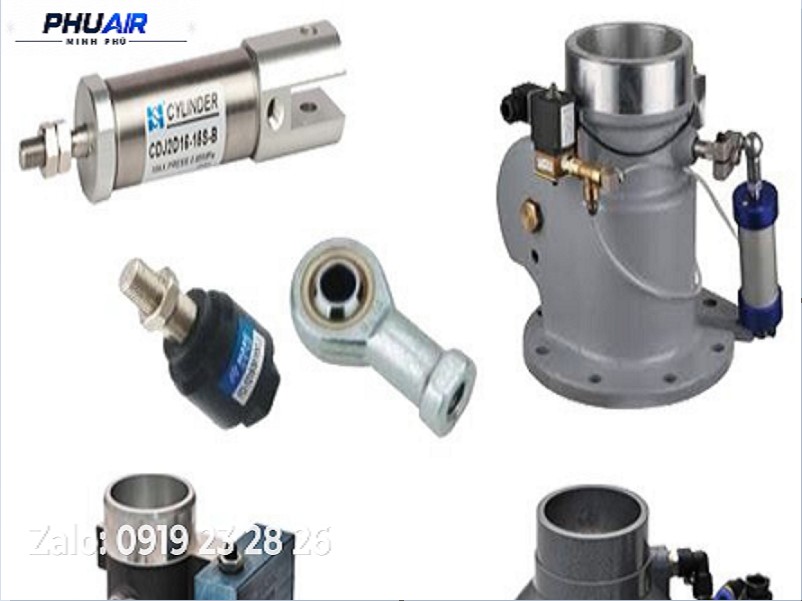
Piston rings maintain the seal between the piston and cylinder wall during the compression process.
When the piston rings or cylinder are excessively worn, compressed air may leak down into the crankcase instead of being retained in the compression chamber.
Possible Symptoms
The compressor builds pressure slowly.
Air flow rate decreases.
A significant amount of air escapes toward the crankcase.
Abnormal smoke or oil vapor is present in the breather system.
The compressor has to operate longer to reach the same pressure level.
However, slow pressure build-up alone should not be used to conclude that the piston rings are faulty. Valve condition, air filter, drive system, and air demand should also be inspected.
If the piston rings need to be replaced, piston ring end gap, side clearance, and cylinder condition must be checked according to the manufacturer's specifications.
After replacement, the run-in process must also follow the manufacturer's instructions rather than applying a fixed time period to all models.
2.5. Drive Belt or Drive Mechanism Slipping
For belt-driven piston compressors, a drive belt that is:
Loose.
Worn.
Cracked.
Slipping.
Broken.
may cause the actual rotational speed of the airend to fall below the required level.
In this case, the compressor may still produce operating noise and the motor may still rotate, but compression efficiency will decrease.
Inspection Method
After disconnecting the power supply and ensuring safety:
Check the condition of the drive belt.
Check belt tension according to the manufacturer's specifications.
Check whether the pulley is misaligned.
Check for signs of belt slippage or surface burning.
Do not estimate belt tension by hand if the manufacturer has specified a specific measurement method.
2.6. Air Leakage or Air Demand Exceeding Supply Capacity
Not every case where the compressor fails to reach the required pressure originates from the airend.
If there is significant leakage in the piping system, valves, receiver, or air-consuming equipment, the air generated by the compressor may be consumed immediately before sufficient pressure can accumulate.
Similarly, if the factory's air demand increases beyond the compressor's supply capacity, pressure may also drop or build up very slowly.
Inspection Method
Check the fittings.
Check the drain valve.
Check the automatic drain valve.
Check the piping.
Listen for abnormal air leakage.
Use soapy water to identify certain external leakage points.
For large production systems, both air supply flow rate and air consumption flow rate should be assessed rather than relying solely on the pressure gauge.
3. Safe On-Site Inspection Sequence
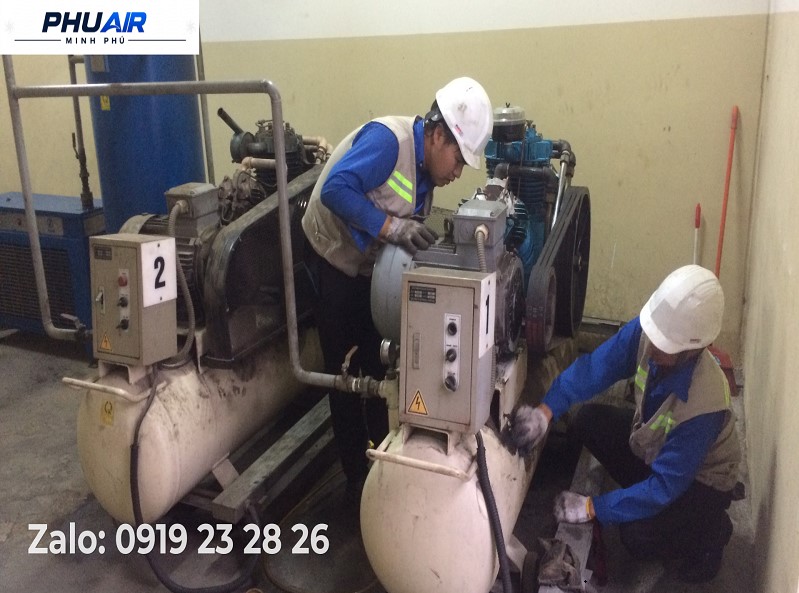
⚠️ WARNING: An air compressor may contain electrical energy, mechanical energy, and residual pressure. Do not disassemble the airend assembly, valves, or piping before fully completing the energy isolation and pressure release procedures.
Step 1: Stop the Compressor and Isolate Energy
Press STOP.
Disconnect the power supply.
Apply lockout/tagout procedures in accordance with the plant's LOTO procedure.
Close the necessary valves.
Release pressure from the receiver and the section of the system being worked on.
Begin disassembly only after confirming that the equipment is in a safe condition.
Step 2: Check the Gauge and Actual Pressure
Determine:
Does the displayed pressure change?
Does the gauge show any signs of damage?
If the system is equipped with a sensor, is the sensor reading consistent with the mechanical gauge?
Step 3: Perform an External Inspection
Check:
Piping leaks.
Drain valve.
Automatic drain valve.
Air filter.
Drive belt and pulley.
Unloading mechanism.
Step 4: Inspect the Valve Assembly
If the external factors are normal, a qualified technician should then inspect the intake/discharge valve assembly.
Check:
Valve plates.
Carbon deposits.
Sealing surfaces.
Gaskets.
Signs of bending, cracking, or breakage.
Step 5: Inspect the Piston Rings and Cylinder
Perform this step only when there are signs of reduced compression efficiency and external causes have been ruled out.
Measure and inspect according to the technical specifications for the specific machine model.
Step 6: Reassess After Corrective Action
After the repair, recheck:
Pressure build-up time.
Operating pressure.
Motor current.
Operating temperature.
Leakage condition.
Duty cycle.
Post-repair assessment helps confirm that the root cause has been addressed, rather than simply replacing a component and continuing to monitor the problem.
4. Mistakes to Avoid
Disassembling the Airend Immediately When the Compressor Fails to Build Pressure
This is a common mistake that can lead to unnecessary component replacement.
External causes such as leakage, air filter condition, drive belt, and unloading mechanism should be checked first.
Arbitrarily Adjusting the Unloading Mechanism
Changing the valve stroke or pilot valve settings without technical documentation may cause the compressor to operate in an incorrect mode.
Adding Oil Without Identifying the Cause
Lubricating oil is not a direct solution for every case where the compressor fails to build pressure. Check the oil level and the cause according to the manufacturer's instructions before adding oil.
Ignoring the Duty Cycle
If the compressor has to run continuously to compensate for pressure loss caused by leakage or insufficient capacity, operating temperature and wear may increase.
Especially for piston compressor models with a specific duty cycle limit, the designed specification must be followed.
5. When Should You Repair, and When Should You Consider Replacing the Compressor?
The decision to replace a compressor should not be based solely on its age.
For example, if a compressor has been in operation for more than 10 years but remains mechanically sound, spare parts are still available, and repair costs are reasonable, continued operation may still be appropriate.
Conversely, if a compressor over 10 years old is simultaneously experiencing multiple issues such as:
Reduced compression efficiency.
Repeated failures.
Increasing spare parts costs.
Extended downtime.
Difficulty sourcing spare parts.
High energy consumption.
the business should evaluate TCO (Total Cost of Ownership) before deciding whether to continue repairing the compressor or invest in new equipment.
Energy Consumption Must Also Be Included in the Assessment
In many industrial compressed air systems, energy is one of the largest lifecycle costs of the equipment and can account for more than 70% of TCO under certain operating conditions.
Therefore, when evaluating an old air compressor, do not ask only:
"How much will the repair cost?"
Instead, ask:
"After the repair, how long can the compressor continue operating efficiently, and what will the total cost of electricity + maintenance + downtime be?"
This provides a more appropriate basis for comparing repair - overhaul - compressor replacement.
6. Frequently Asked Questions
What should be checked first when a piston air compressor runs but fails to build pressure?
Check in order from the simplest to the most in-depth: pressure gauge - leakage - air filter - drive belt/drive system - unloading mechanism - valve assembly - piston rings and cylinder.
Do not disassemble the airend before external causes have been ruled out.
Can worn piston rings cause a piston compressor to build pressure slowly?
Yes, they can. When the piston rings no longer provide adequate sealing, some compressed air may leak into the crankcase, reducing compression efficiency.
However, slow pressure build-up can also result from the air filter, intake/discharge valves, drive belt, leakage, or high air demand. Therefore, the entire system should be inspected before reaching a conclusion.
Why does air leak from the intake port while the compressor is running?
This may be related to the intake/discharge valve assembly or unloading mechanism, depending on the design of the specific model.
Do not determine which component needs to be replaced based solely on the location where the air leakage noise is heard.
How often should the air filter on a piston compressor be replaced?
There is no fixed interval applicable to every compressor. 3,000 hours may be used as a reference interval under certain conditions, but the manufacturer's specifications and the actual filter condition should take priority.
Is it a problem if a piston compressor runs continuously?
This depends on the design and duty cycle of the specific model.
If the compressor continuously has to run to compensate for pressure loss, the causes—such as leakage, insufficient capacity, or reduced compression efficiency—should be investigated rather than simply allowing the compressor to run for longer periods.
7. PhuAir Supports Piston Air Compressor Diagnosis
If a piston air compressor continues to run but fails to build pressure or has an abnormal pressure build-up time, do not replace components based on guesswork.
To help PhuAir narrow down the cause, you can prepare:
Machine nameplate photo: Manufacturer, model, and main specifications.
Pressure gauge photo: Taken while the compressor is running.
Short video: Record the operating sound and any area with abnormal air leakage noise, if present.
Condition description: Whether the compressor suddenly stopped building pressure or pressure has gradually decreased over time.
Recent repair/maintenance history: If available.
The PhuAir technical team will use the machine model, actual symptoms, and operating data to help narrow down the cause and recommend the appropriate inspection, repair, or spare parts replacement approach.
Conclusion
Piston air compressor** failing to build pressure does not necessarily mean that the airend or piston rings are faulty.** The cause may begin with simple issues such as leakage, air filter condition, drive belt, or unloading mechanism.
The most effective approach is to diagnose systematically from the outside to the inside, ruling out each possible cause before disassembling the airend assembly or replacing components.
If the cause has not been identified, send the machine nameplate photo + pressure gauge photo + condition video to PhuAir for assistance in narrowing down the issue based on the specific machine model.