

Air Compressor Does Not Run When Pressure Drops: Is It a Fault?
Not every case where an air compressor does not run when pressure drops is necessarily a fault. In many cases, this may be a normal operating condition because the compressor is in an inappropriate control mode, has not yet met the start conditions, or is receiving a lockout signal from the control system.
However, if the pressure in the receiver has dropped below the configured setpoint but the compressor still does not start, especially when the condition repeatedly occurs, the control system and related equipment should be inspected. The following article helps operators distinguish whether the compressor is not running due to normal control operation or an actual fault, while also providing an appropriate inspection sequence.
💡 QUICKLY DISTINGUISH PRESSURE AND OPERATING SYMPTOMS
Symptom | Main Inspection Focus |
|---|---|
Motor does not start | Check Auto/Manual mode - Alarm code - Interlock conditions - Start command signal. |
Motor runs but remains unloaded | Check the inlet valve - Load/Unload control mechanism - System configuration. |
Compressor runs but pressure remains low | Check air consumption demand - System leakage - Compressor capacity - Distribution network. |
Mechanical gauge shows low pressure but the display shows high pressure | Check the Pressure Sensor signal - Accuracy of the signal circuit. |
1. Quick Answer
An air compressor that does not run when pressure drops is not necessarily experiencing an equipment fault. The condition may be caused by the compressor not yet reaching the configured start threshold, remaining in Manual mode, having a protection Alarm/Fault code, or having a Pressure Sensor that reads differently from the actual pressure. If the compressor is in Auto mode, the pressure has reached the start condition, but the compressor still does not run and there is no lockout signal, this is an abnormal condition that requires a technician to inspect the control circuit, contactor, or inverter.
2. Quick Diagnosis Table: When Pressure Is Low but the Compressor Does Not Run
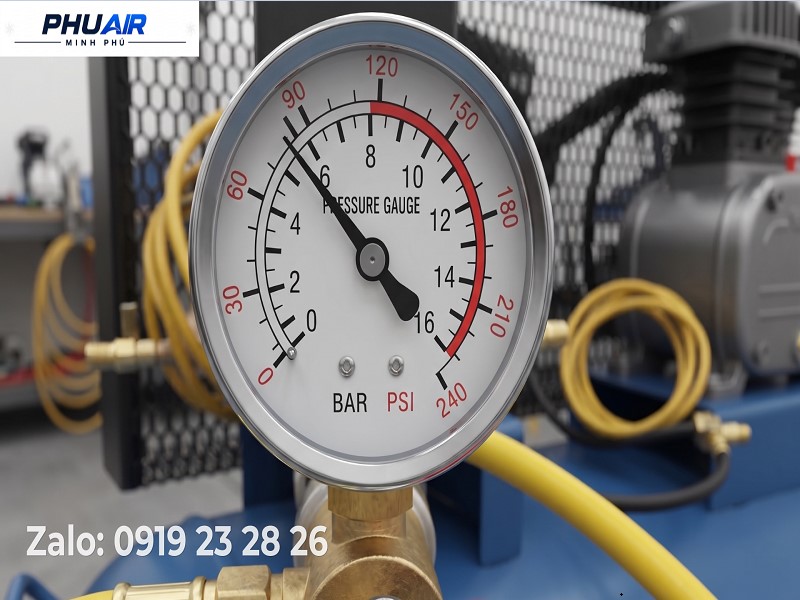
3. How Does the Pressure Control System Work?In an air compressor system with automatic control, the compressor is typically configured to start or stop based on system pressure. For example, a system may be configured with a Stop setpoint of 8.0 bar and a Start setpoint of 6.5 bar. When the pressure drops to the configured start condition, the controller executes the corresponding operating command according to the machine configuration, such as starting the compressor or switching it to the loaded state. However, if the pressure drops while the machine remains idle, the following root causes should be carefully reviewed before concluding that the compressor has a fault. 4. 10 Common Causes Why the Pressure Is Low but the Compressor Does Not Run |
- The machine is in Manual mode: The machine is operating in manual mode and therefore does not automatically start when system pressure drops.
- The pressure has not actually fallen below the start threshold: The current pressure is still above the configured Start threshold, so it is completely normal for the machine not to receive a start command.
- The pressure sensor is reading an incorrect value: A discrepancy between the mechanical pressure gauge and the electrical signal from the sensor causes the controller to mistakenly assume that the pressure remains within the safe range.
- The machine has a stored Alarm/Fault code: Faults such as High Temperature, Overload, Sensor Fault, and Phase Loss can interlock the start command to prioritize equipment protection.
- The Emergency Stop button is activated: The safety circuit is interrupted, preventing the machine from running even when the system has an air demand.
- The protection relay or overload device has tripped: Mechanical relays interrupt the control circuit due to a previous electrical fault.
- No Start command signal has been received from the controller: The input safety-condition sequence has not yet been confirmed as complete by the controller.
- The contactor or inverter has a fault: The control circuit has issued a command, but the power circuit does not close to energize and rotate the motor.
- The machine is in Standby mode or locked by the central system: In a system with multiple compressors operating in parallel, this machine may be assigned to standby mode while another machine takes the load.
The central control system has not permitted the machine to start: In a multi-compressor system or a load-distribution control system, the central controller may not yet have sent a run command to this machine even though system pressure is low.
5. 6-Step Practical Diagnostic Inspection Procedure
Step 1 - Check the Actual Pressure: Record the pressure value shown simultaneously on the electronic display and mechanical pressure gauge.
Step 2 - Check the Start/Stop Thresholds: Identify the actual configured setpoints for comparison.
Step 3 - Check the Operating Mode: Make sure the machine is in Auto mode if automatic pressure compensation is required.
Step 4 - Check Alarm/Fault Codes: Review the fault history on the control display and do not repeatedly press Reset.
Step 5 - Check the Pressure Signal: Compare the deviation between the electronic sensor reading and the mechanical pressure gauge.
Step 6 - Check the Start Command: Determine whether the controller is actually issuing the output command. Note: Electrical signal measurements inside the control cabinet must be performed by a qualified technician after the necessary safety measures have been implemented.
6. Frequently Asked Questions (FAQ)
If the air compressor pressure is low but the machine does not run, does this necessarily indicate a fault?
Not necessarily. The machine may not have reached the configured Start threshold, may be in Manual mode, or may be locked out by a safety fault code.
The machine is set to Start at 6.5 bar, but it does not run even when the pressure drops to 6.0 bar. What should be done?
If the machine is in Auto mode, has no Alarm/Fault or interlock, and 6.0 bar is below the actual start threshold used by the controller, this indicates an abnormal condition that requires inspection of the sensor signal, central control circuit, or contactor.
7. Conclusion
Unauthorized removal of the electrical cabinet, bypassing the safety circuit, or replacing the pressure sensor without clearly understanding the root cause can result in unnecessary costs and create operational safety risks.
👉 Take photos of the control display, mechanical pressure gauge, and machine nameplate and send them to PhuAir via Zalo. Our experienced engineering team will help you analyze the fault code, verify the configured parameters accurately, and recommend the most cost-effective corrective solution.