

1. Quick Answer
A screw air compressor running continuously without stopping (or remaining in the loaded or unloaded state for an extended period without shutting down automatically) does not necessarily mean the machine is faulty. Before reaching a conclusion, determine whether the compressor is running continuously because of:
High actual air demand - the system genuinely requires a large volume of air over an extended period. This is a normal operating response; or
A system abnormality - typically falling into one of the following categories:
Compressed air leaks (pipelines, valves, elbows, fittings, and pipeline endpoints).
Inappropriate Load/Unload pressure settings or an excessively long Auto-Stop timer setting.
Pressure sensor errors or abnormal control signals.
A stuck or faulty Inlet Valve (suction valve) or solenoid valve.
Reduced pressure-building capability (filters, oil separator, cooling system, etc. requiring maintenance).
The key to an accurate diagnosis is determining whether the compressor remains continuously in LOAD or UNLOAD. These two operating states point to different groups of potential causes.
⚠️ Safety Precautions Before Inspection
Do not abruptly disconnect the power supply while the compressor is operating under a heavy load, as this may cause mechanical impact.
Always fully release residual pressure from the air receiver and pipelines before removing or opening any components.
Inspection inside the electrical cabinet and control circuits must be performed by qualified technicians.
Do not ignore protective alarms (Alarm/Fault) or force the compressor to continue running before the cause has been identified.
2. Does Continuous Compressor Operation Always Indicate a Fault?
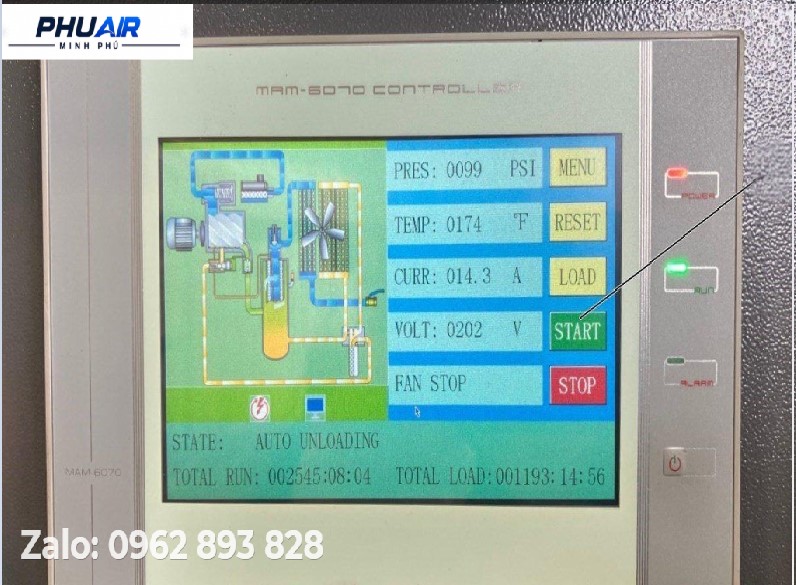
No. If downstream equipment is consuming a large amount of air, the compressor may need to remain in the loaded state for an extended period. This reflects actual load demand, not a malfunction.
The first question to answer is: Is the compressor running continuously because the system genuinely needs air, or because the machine is unable to meet the conditions required to switch to Unload or shut down?
Case | What Needs to Be Assessed |
|---|---|
Actual air demand is high | Compressor airflow, required pressure, number of air-consuming devices in operation, and the system's ability to meet demand |
Air demand is not high, but the compressor continues running | Air leaks, control settings, the Load/Unload system, sensors, and pressure-building capability |
3. Quick Diagnostic Table
Symptom | Data to Verify | Potential Causes to Investigate |
|---|---|---|
Compressor runs continuously without reaching the unloading pressure threshold | Whether the machine is in LOAD or UNLOAD; actual air demand | System leaks or increased air demand |
Pressure has reached or exceeded the threshold, but the compressor remains in LOAD | Pressure displayed by the PLC compared with an independent mechanical pressure gauge | Pressure sensor deviation; faulty solenoid valve or Inlet Valve |
Compressor switches to UNLOAD but does not shut down completely | Auto-Stop timer setting | Timer setting is not appropriate for the frequency of air consumption |
Compressor repeatedly switches between LOAD → UNLOAD → LOAD | Duration of each operating-state cycle | Abnormal control system, valve operation, or signals |
Compressor builds pressure very slowly | Maintenance history and parts replaced | Reduced pressure-building capability (filters, oil separator, cooling system) |
The issue appears after a production change | Recent changes in production output or equipment | Actual increase in air demand |
The issue appears after maintenance | Parts and procedures involved in the most recent maintenance | Review and cross-check maintenance history |
The compressor displays an Alarm/Fault | Alarm code and conditions under which it occurred | Record the information and send it to a technician for inspection |
When the available data is insufficient, do not conclude that there is only one cause. Clearly distinguish between verified data, hypotheses requiring investigation, and the final diagnosis.
4. Why Is It Necessary to Distinguish Between LOAD and UNLOAD?
This is the most important step before proceeding with further inspections because the two operating states lead to different diagnostic approaches:
If the compressor remains in LOAD — investigate air demand → air leaks → pressure-building capability → overall system condition.
If the compressor remains in UNLOAD (running unloaded for an extended period without shutting down completely) — investigate the Auto-Stop setting → sensors → control signals → Load/Unload valves.
5. Practical Inspection Procedure
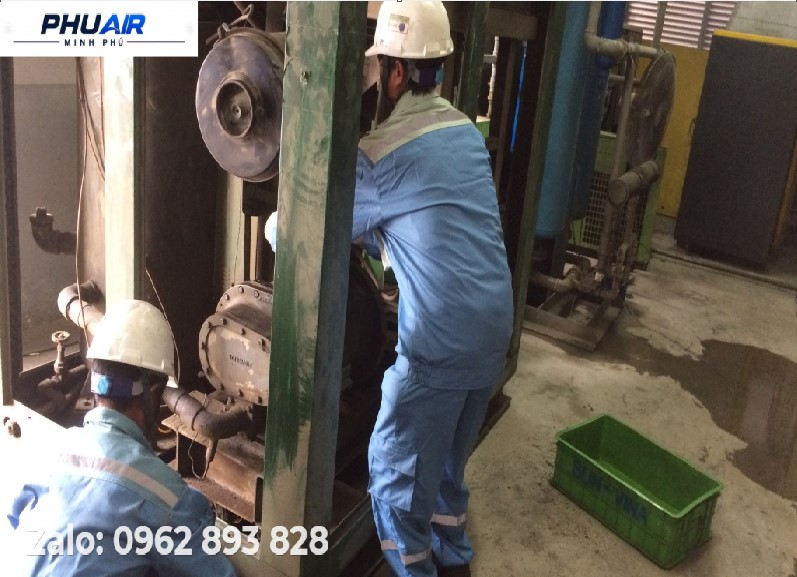
Step 1 – Record the Machine Condition
Record the machine brand, model, power rating, serial number, current pressure, LOAD/UNLOAD status, alarm code (if any), and when the issue first appeared.
Step 2 – Determine Whether the Machine Is in LOAD or UNLOAD
Check the controller display to identify the current operating state, then select the appropriate inspection procedure in Section 4.
Step 3 – Check Actual Air Demand and Air Leaks
Record any recent changes: increased production output, additional equipment, extra production shifts, or abnormal operation at any point of air consumption.
Inspect common leak locations: pipelines, valves, elbows, fittings, couplings, filters, air-consuming equipment, and pipeline endpoints.
Suggested approach: close the air supply valve from the receiver to the production area, if operating conditions permit a temporary interruption, and observe whether the compressor unloads as designed. A technician should assess this procedure beforehand because a sudden air supply interruption may affect an operating production line.
If measurement is possible, record data before and after repairing leaks to evaluate the results. Do not estimate a specific air loss figure or electricity cost without actual measurement data. Leakage losses vary considerably between systems depending on pressure, leak size, and leak duration.
Step 4 – Check the Pressure Sensor and Control Settings
Compare the pressure displayed on the controller with an independently installed mechanical pressure gauge. If the two readings differ significantly, the sensor may be reporting an incorrect value, causing the controller to make LOAD/UNLOAD decisions that do not correspond to actual pressure.
Check the Load threshold, Unload threshold, and unloaded running time before shutdown (Auto-Stop Timer). If the timer is set too long relative to the factory's actual air consumption pattern, the machine may remain unloaded for an extended period without shutting down completely.
Do not arbitrarily increase the unloading pressure above the design limit to make the machine “unload faster” or supply enough air. Doing so may overload the motor, affect the safety valve, and reduce Airend service life. All parameter changes must be checked against the technical documentation for the specific machine model.
Step 5 – Inspect the Inlet Valve and Solenoid Valve
Observe the opening and closing mechanism of the Inlet Valve when the machine switches to Unload. A valve stuck open, a faulty valve cylinder, or a solenoid valve with a burned-out coil or a sticking control air circuit may allow air to continue entering the Airend even after the machine receives an Unload signal.
Step 6 – Review Maintenance History
Check the most recent maintenance date, the materials and parts replaced, and whether the issue began immediately after maintenance or an operational change. This is important information to provide to the technician when reporting the fault.
Step 7 – Reach a Conclusion Only When Sufficient Data Is Available
Do not replace parts based on guesswork or conclude that a specific component is faulty solely because the “machine runs continuously.”
6. Mistakes to Avoid
❌ Arbitrarily increasing the unloading pressure to ensure sufficient air supply. This may overload the motor, affect the safety valve, and reduce Airend service life.
❌ Replacing the pressure sensor immediately without comparing its reading against an independent mechanical pressure gauge.
❌ Ignoring small air leaks. Even a small leak can force the compressor to continuously replenish lost air, increasing running time and electricity costs over time. The actual impact must be measured rather than estimated.
❌ Diagnosing the cause solely from the symptom of “continuous running” without distinguishing between LOAD and UNLOAD or checking actual air demand.
❌ Replacing parts based on guesswork before verifying the data, including actual pressure, maintenance history, and sensor signals.
7. Does Continuous Operation Increase Electricity Costs?
It can—if the machine operates under unnecessary conditions, such as remaining unloaded for an extended period despite low air demand, or if system leaks force it to work harder than necessary.
However, electricity costs should not be calculated based solely on machine running time. An accurate assessment requires actual data, including machine power rating, running time, load state (Load/Unload), pressure, airflow, air demand, and the system's specific operating conditions. Any estimated savings or losses should be calculated using actual measurement data, not rough estimates.
8. Should You Shut Down a Continuously Running Machine?
The decision should not be based solely on how long the machine has been running. If it is meeting normal production demand, continuous operation may be necessary under the current operating conditions.
Conversely, if the machine runs continuously under abnormal conditions accompanied by any of the following:
Pressure does not reach the level achieved previously.
Abnormally high temperature.
An Alarm/Fault.
Abnormal vibration, noise, or a burning smell.
stop the machine in accordance with the applicable safety procedures and contact a technician, rather than forcing it to continue operating before the cause has been identified.
9. When Should You Call a Technician?
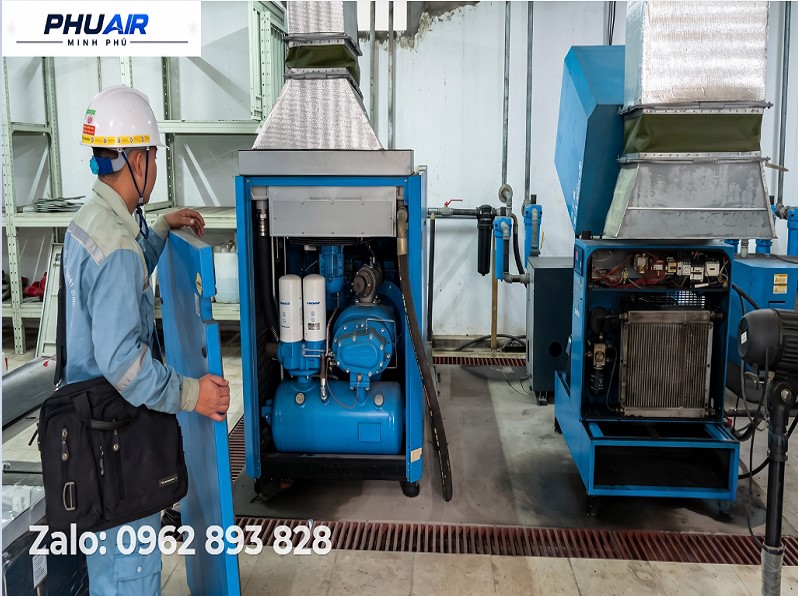
Contact a technician when:
The machine runs continuously even though air demand has not increased.
Pressure does not reach the level achieved under previous operating conditions.
The machine exhibits abnormal LOAD/UNLOAD behavior, such as frequent or unstable state changes.
The pressure sensor appears to provide readings that differ from the mechanical pressure gauge.
The machine displays an Alarm/Fault.
Abnormal noise, vibration, or a burning smell occurs.
Basic operating conditions have been checked, but the cause remains undetermined.
Information to Prepare When Contacting Technical Support
Machine brand, model, power rating, and serial number.
Current pressure and LOAD/UNLOAD status.
Alarm code, if available.
When the issue began and how long the machine has been running.
The factory's current compressed air demand.
Most recent maintenance history.
Recent changes to the system, such as additional equipment, increased shifts, or production expansion.
Photos of the machine nameplate and controller screen, and a video of the issue, if available.
The more initial data available, the more evidence-based the diagnosis can be. Avoid providing only a vague description such as “the machine runs continuously.”
10. Frequently Asked Questions (FAQ)
Does an air compressor running continuously mean it is faulty?
Not necessarily. The machine may run continuously because compressed air demand is high. If demand has not increased but the machine continues to run abnormally, the load, air leaks, pressure, and control system should be inspected.
Why does an air compressor run continuously without increasing pressure?
Possible causes include high air demand, air leaks, or reduced pressure-generating capacity in the system. Actual operating data, such as pressure measurements and maintenance history, are needed to identify the specific cause.
Does an air compressor consume electricity when running continuously in unload mode?
Yes. A screw air compressor continues to consume electricity while running unloaded, even though it does not produce useful compressed air. The exact consumption depends on the model and operating conditions; consult the machine's technical documentation.
Why does the machine fail to switch to Unload even after the pressure reaches the unloading threshold?
Possible causes include a burned-out solenoid coil controlling the inlet valve, a blockage or sticking issue in the control air circuit, or a control board that fails to issue the unloading signal.
Does a continuously running machine always need new filters?
No. Do not replace a component solely because the machine runs continuously. Inspect the system and verify the cause first.
Should I adjust the pressure setting so the machine stops earlier?
Do not make adjustments without proper assessment. Evaluate the system's actual requirements and check the technical documentation for the specific machine model.
What information should I provide to help the technician inspect the machine more quickly?
At a minimum, provide a photo of the machine nameplate, model, power rating, controller screen, current pressure, LOAD/UNLOAD status, alarm code, and a description of when the issue occurs.
11. Conclusion
A screw air compressor running continuously without stopping does not necessarily mean the machine is faulty. The diagnostic sequence should follow this order:
Identify LOAD/UNLOAD status → Check air demand → Check for leaks → Check sensors and control settings → Inspect the Inlet Valve/solenoid valve → Review maintenance history → Reach a conclusion only after sufficient data is available.
This approach helps prevent assumptions, avoid unnecessary component replacement, and maintain operational safety throughout the inspection process.
📞 Need On-Site Inspection Support?
If your air compressor runs continuously even though air demand has not increased, pressure behaves abnormally, or Load/Unload operation differs from its previous behavior, send the following information:
Photos of the machine nameplate and controller screen.
Current pressure and LOAD/UNLOAD status.
A description or video of the issue.
Send these details to the technical team so they can determine the next inspection steps based on actual operating data, rather than reaching a conclusion or recommending replacement parts without sufficient evidence.